
Digital Workplace
Enable remote working for staff and let technology, people and processes unite
Share. Engage. Connect

Today’s always-connected, instant-access working environment has questioned the need for office-based working. Like never before, staff are connecting and collaborating with their peers in real-time, from any location.
As more staff transition to a work-from-home scenario, digital workplace technology offers a vital agile setting for businesses. Digital workplace technology can improve productivity, creative thinking, and team collaboration.
While some organizations have already embraced a digital workplace culture, others are being forced unexpectedly into managing staff remotely. The silver lining for the latter cohort is that if done right, remote working can facilitate a smarter, faster, better operation. Businesses stand to benefit from increased employee engagement and all-round improved business performance.
What is the Digital Workplace?

One of the most accepted definitions of the digital workplace is “the alignment of technology, employees and business processes to improve operational efficiency and meet organizational goals”.
Gartner describes it as a way of enabling new, more effective ways of working; raising employee engagement and agility; and exploiting consumer-oriented styles and technologies.
It’s been dubbed as the fourth industrial revolution, the digital transformation.
New digital workplace practices are being embedded into everyday life, across every size and type of business. Artificial intelligence, automation, and machine learning technology are taking over manufacturing, service work, and many other essential business tasks. And while most companies acknowledge the benefits of digital working, many admit to lacking the technical knowledge to lead the way (source: McKinsey & Company).
Distributed Working: The New Normal

The way in which we spark ideas and get work done has changed forever. With more employers supporting the distributed workforce model – either through choice or an unexpected crisis – the practical side of completing tasks and communicating with colleagues now, more-often-than-not, takes place in a digital space. Indeed, many economists forecast the physical office will soon be a thing of the past, accelerated by the recent Covid-19 pandemic.
A distributed workforce – also known as remote workers, digital nomads, telecommuters or home office workers – work from any location, across multiple devices. They value work/life balance, flexible hours – and critically, the need to feel connected. Digital workplace technology provides this essential connection – emphasizing the importance of friction-free, easy-to-use software.
If the physical office is no longer a place we go to work, these digital touchpoints play a vital role in how employees stay motivated, informed and engaged in what they do.
The onus will be on the employer to optimize the digital workplace experience for employees. Security, fast access, as well as intuitive and compatible software are just some of the important considerations when transitioning into a digital world.
Key Benefits Of A Digital Workplace Strategy
The advantages of adopting a digital workplace strategy spread wider than most businesses originally anticipate. Here are some of the expected and unexpected benefits:
Team Collaboration
Improved levels of problem-solving, interaction and knowledge-sharing – all-round improved collaboration
Flexible Remote Working
Allows employees to work from home, supporting more flexible working
Productivity Boost
Increased efficiency and employee productivity through improved communications
Innovation
Great ideas can come from anywhere – not just the boardroom – if staff have the right channels
Change Management
Clear, reliable communications minimizes confusion and garners internal support
Improved Transparency
Improved traceability and transparency amongst teams, reducing errors
Hidden Savings
Decreased employee commuting expenses and business real estate cost
Employee Experience
Improved personal experiences through greater inclusivity and integration of tasks
Retain Talent
Lower employer turnover rates due to improved work/life balance and engagement
The Digital Workplace Framework
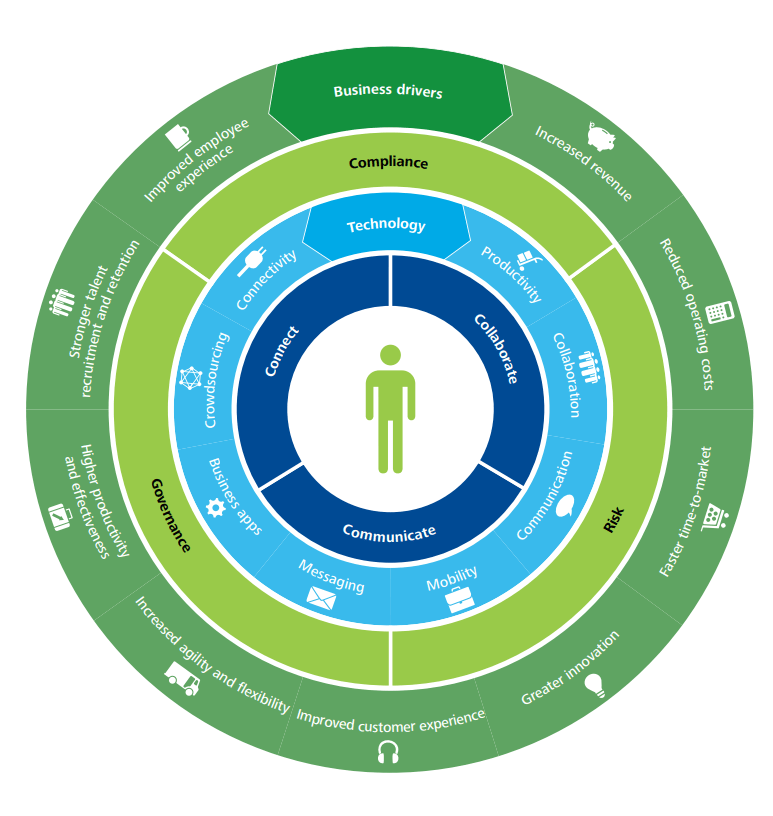
Deloitte has developed a four-layer framework to help govern the design of a digital workplace. This is a useful guide for those businesses looking for workplace transformation. This framework comprises of:
1) Use – for staff to collaborate, communicate and connect
2) Technology – the digital tools to enable staff to do their job
3) Control – having the right governance structure and compliance controls in place to reduce risk
4) Business drivers – measuring the outcomes and actual business value.
It explains how to leverage your investment to support a new and better way of doing business that will enhance both the employee experience and the customer experience.
Tips For Deploying A Digital Workplace
Here are some practical tips to help you blend your existing applications with new technology to create the ultimate user experience and a high-performing work environment.
1. Involve the right people to steer the project. Senior ownership is vital, but including representatives who will drive the technology is also key.
2. Ensure alignment with business strategy. Keep your big picture always in mind i.e. ‘will this new tool and process-change enable us to achieve our goals?’
3. Consider internal culture. How amenable will staff be to new technology and digital experiences? Develop an internal communications program to explain the benefits of digital technology and how vital it is in today’s workplace. And most of all, make it easy for staff to do their job.
4. Deliver business value. Avoid falling for the ‘shiny new thing’. Stay true to the original outcomes your business needs.
5. Research technologies. A good case study, a free trial, a call with a current user – these are all helpful ways to shortlist new technologies. There are multiple service providers playing in a very dynamic, competitive digital market.
6. Consider risk, compliance and legal consequences. There are important regulations surrounding data management and security that must be adhered.
Digital Workplace: Future Trends
What are the anticipated trends at play when today’s graduates become tomorrow’s C-suite, artificial intelligence is mainstream, and the traditional office is no more?
Here’s our view of the future and the role of the digital workplace:
Cloud-based Solutions
Effective, cloud services with unlimited access will be essential to support remote working
No Standing Still
Technology will continue to evolve, either organically or intentionally. Status quo is not an option
All-On Automation
Traditional ways of working will continue to be disrupted; automated processes will increase
Tech Choice Matters
Technology stack choices will become more important when attracting staff and tech compatibility
Staff Expectations
Young workers have a huge appetite for social tools and tech, increasing pressure for employers to invest
Customer Self-Service
Customers will want to search and solve their own questions independently, without speaking with an agent
Overwhelming Options
Choice-explosion of SaaS products could be overwhelming; apps may fail to work together
Employee Experience
Employers will try harder to motivate, engage, inspire and involve staff to retain talent
Tech Maze
Employees become ‘trapped in the tech maze’ with many apps overlapping and staff feeling bamboozled
❝
The Digital Workplace is a work in progress, an ongoing journey, with only 14% of companies believing they are at a ‘mature phase’.
Source: Digital Workplace Group
Digital Workplace Software
Core to the successful adoption of a digital attitude is finding ways to support staff as they navigate through the tech maze of the modern digital workplace, along with adjusting to working from home. While there are countless business apps and platforms suited to their specific areas of business, a central hub – or gateway if you like – where staff can access everything they need to complete their job is vital.
MyHub intranet software provides that central digital space for staff to communicate, share and source company information, regardless of their location. Our cloud-hosted, single access point makes life easier for staff, helping them do their job better.
From instant messaging to the seamless integration of business applications, workflow automation to access-controlled content libraries, MyHub brings together all this into a beautifully-sleek, easy-to-navigate digital workplace. All accessible with a single sign-on.
Digital Workplace Tools: The MyHub Difference
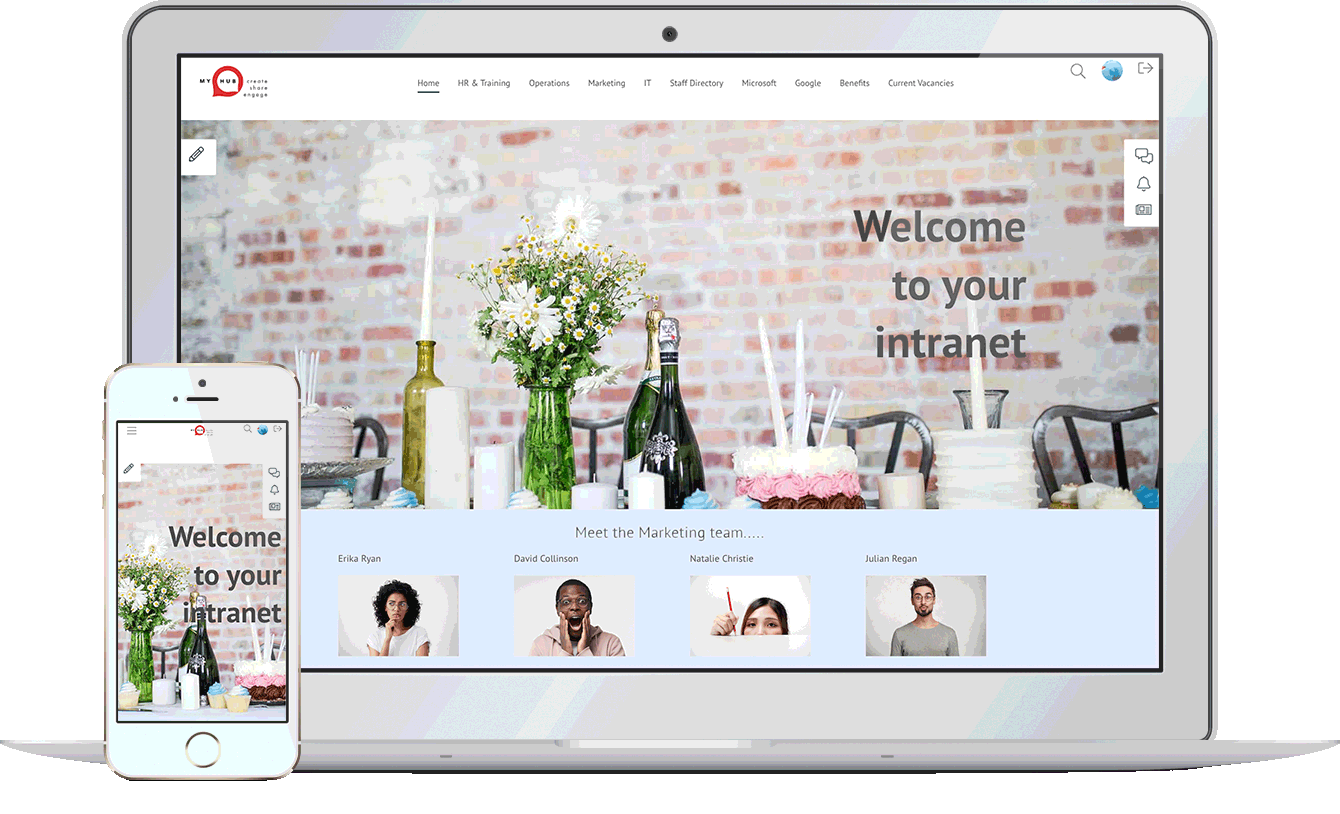
Considered the central hub of your digital workplace solution, MyHub is fully scalable, designed to support your company’s growth. And fully customizable, to meet your exact needs.
Designed with the non-technical buyer in mind, MyHub requires no coding skills or IT experience. It is simple to set-up – and fun to use!
Using simple drag-and-drop functionality, you can create a professional digital workspace in minutes! Being cloud-hosted also means you’re future-proofing your investment: you get to benefit from our latest new features and enhancements as soon as they’re released.
Let our technology unleash a smarter and super-efficient digital workplace solution that your staff will love.
❝
Managers have reduced the time spent on management activities by one to three hours due to system integration and collaboration tools
Useful Digital Workplace Resources

Employee Experience Management: The HR Guide
Employee experience (EX) encompasses every interaction an employee has with the organization—from hiring and onboarding to day-to-day workflows and eventual departure. It’s not just about policies; it’s about shaping a cohesive, supportive environment that acknowledges employees as the heart of the enterprise. A well-crafted EX strategy centers on creating meaningful journeys, leveraging technology, and listening actively to employee needs
Modern digital tools—like social intranets, internal communication platforms, and employee experience suites—serve as the backbone of a positive EX. These platforms integrate communication feeds, document hubs, recognition tools, training modules, and community features to provide a seamless and engaging employee journey. The result is better collaboration, faster information flow, and a more inclusive workplace for all staff, including desk-based, frontline, and hybrid workers .
Ultimately, organizations that prioritize employee experience see dividends in engagement, productivity, and retention. Enabling employees with the right digital tools, continuous development opportunities, and channels for feedback not only boosts morale but also drives tangible business outcomes. The digital workplace becomes more than a technology stack—it becomes a vibrant, living ecosystem that supports people and performance alike .

Collaborative Communication: Why It Matters
In today’s dynamic business environment, traditional hierarchical structures are giving way to more collaborative and flexible models. With the rise of remote work and diverse teams, effective communication has become the cornerstone of successful collaboration. By uniting individuals across various departments and locations, organizations can harness a wealth of ideas and perspectives, leading to innovative solutions and enhanced problem-solving capabilities.
Central to this collaborative effort is the role of communication. It’s not just about sharing information but about fostering an environment of openness, trust, and mutual respect. Providing diverse communication channels—such as instant messaging, video conferencing, and collaborative platforms—ensures that all team members are aligned and engaged, regardless of their physical location. This approach not only facilitates seamless information flow but also strengthens team cohesion and morale.
Moreover, investing in robust communication strategies has tangible business benefits. Organizations that prioritize collaborative communication experience increased productivity, faster decision-making, and a more agile response to market changes. As businesses continue to adapt to evolving work dynamics, embracing collaborative communication is essential for sustained growth and competitive advantage.
Corporate Communication – Examples and Best Practices
Modern corporate communication bridges the gap between leadership and employees, ensuring a unified vision across all levels of the organization. By structuring internal messaging—whether through leadership announcements, policy updates, or team feedback—companies can foster transparency, alignment, and trust.
An intranet serves as the backbone for this process, offering centralized news feeds, staff directories, document storage, forums, and calendars—all accessible across devices. These features help break down silos, simplify information access, and support two-way communication.
Successful corporate communication strategies powered by intranets yield tangible benefits: faster and more consistent messaging (even from CEOs or managers), better collaboration across departments, secure handling of sensitive data, and deeper employee engagement backed by data-driven insights. Additionally, platforms like MyHub streamline the process—enabling alerts, forums, automations, mobile access, and feedback tools—all contributing to enhanced productivity and morale.
Intranet Development: Making Life Easier For An Intranet Developer
The blog emphasizes the transformative benefits of cloud-hosted intranet development over traditional or bespoke systems. By leveraging managed platforms like MyHub, organizations eliminate the complexity of server setup and maintenance, enabling teams to focus on creating impactful user experiences and branded intranet sites.
MyHub brings over 20 years of experience to the table, offering a streamlined development lifecycle that includes planning, design, launch, training, and ongoing support. Their proven process allows for fully branded intranet solutions in under 40 days—dramatically reducing time-to-launch and accelerating business value for agencies and internal IT departments.
Security is treated as a first-class priority: from SOC 2-compliant AWS hosting and SSL encryption to firewall protection and granular access controls. Compared to platforms like SharePoint, which often require patchwork integrations and complex customization, MyHub delivers core functionality right out of the box—enhancing usability, minimizing costs, and maximizing return on investment.

How To Build Trust In A Team: 10 Proven Strategies That Work
Building trust within teams isn’t a one-time event—it’s a continuous process rooted in consistent behaviors. The blog outlines ten proven strategies to cultivate trust: clear communication, giving autonomy, celebrating successes, and more. These insights draw on best practices that create an environment where team members feel safe to take risks and contribute authentically.
Key strategies include fostering transparency by sharing both successes and challenges openly, and embracing accountability by ensuring commitments are honored. Leaders play a pivotal role by modeling reliability and integrity—walking the talk—and by establishing clear processes that remove ambiguity and reduce micromanagement
The post also emphasizes the importance of social connection and shared experiences. Whether through informal gatherings or team-building exercises, these moments build rapport and reinforce mutual support. Recognizing individual and collective achievements further cements bonds, elevating team morale and performance .

55 Questions To Ask A CEO
High engagement levels across organizations have made CEOs more accessible than ever—appearing in town halls, online Q&As, and casual hallway chats. This increased visibility means employees now have rare face-to-face time with top leadership. To make the most of such moments, the blog emphasizes the importance of preparation: thoughtful, well-targeted questions help you stand out, build rapport, and even elevate your career.
The post categorizes 55 insightful questions into key themes: corporate culture, company goals, operations, CEO career path, personal interests, and ways to make the right impression. From probing culture with “What three words best describe our company?” to gaining personal insight via “What motivates you when things get tough?”, each question is framed for specific formats—town halls, small group settings, or one-on-one conversations.
To round it out, the article offers top tips to guide your approach: be prepared with a few select questions, match the tone to the forum, offer your own thoughts when it’s intimate, and above all, remain genuinely enthusiastic. Done right, this isn’t just a chat—it’s an opportunity to connect, learn, and make a positive, lasting impression.